<- Project gallery
GALLERY / PROTOTYPE

Mahoraga

Adaptive RL/game-system prototype with reward shaping, curriculum pressure, and LLM integration.

PythonGymnasiumFastAPIGradioQwen 2.5
The system

An adaptive-combat prototype shaped by rewards; its public UI shows a disconnected sample encounter.

Gallery case study on adaptive AI systems and reward-loop design.

Project visuals

See the system before the explanation.

Diagrams and project artifacts, each shown with its current evidence status.

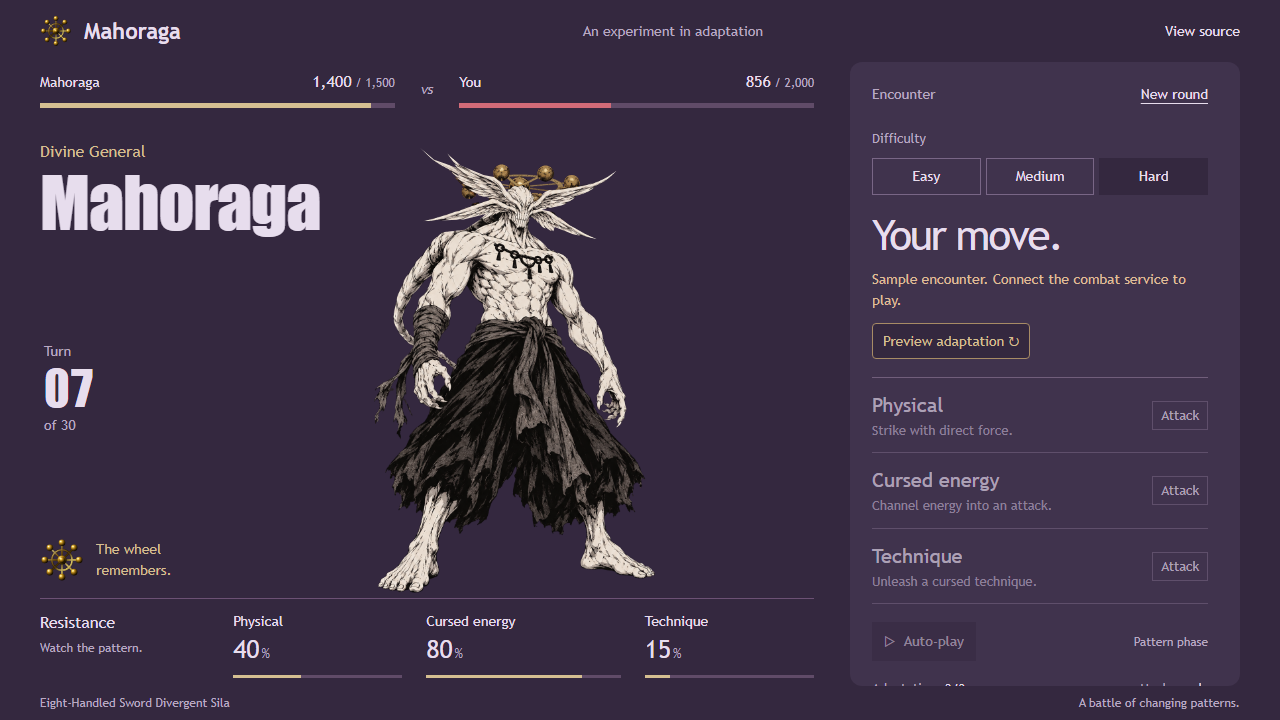
Purple Mahoraga arena showing sample health and resistance values with a visible notice that the combat service is disconnected
Current public demo UI · sample state Captured from the public demo on 2026-09-25. The page labels this a sample encounter and says the combat service must be connected to play; shown values and disabled controls are not live gameplay evidence.
Mahoraga system diagram showing UI, API, environment, enemy, rewards, Gym wrapper, and LoRA training loop
System loop diagram Generated from repo diagram docs and Mahoraga source inspection.
Mahoraga reward-loop diagram showing state, action, reward components, anti-cowardice, opportunity, and terminal signals
Reward-loop diagram Shows reward components and known exploit-pressure boundaries.
01 / Build

What exists

Project scope

  • Adaptive-agent environment with state, combat mechanics, and curriculum enemy pressure.
  • Reward shaping around survival, combat, adaptation, anti-cowardice, efficiency, terminal, and opportunity signals.
  • Gymnasium wrapper plus FastAPI/Gradio surfaces and optional Qwen/LoRA paths.

Architecture

  • Mechanics update state and expose the next decision point.
  • Curriculum enemy changes pressure over time.
  • Reward components score behavior and expose reward-hacking risks.
  • Training code stays outside the environment through the Gym wrapper.
02 / Ownership

Backend / RL Systems Engineer

Atishay Jain owned the adaptive backend/game-system logic, agent behavior, reward/training constraints, and LLM/backend integration under hackathon constraints.

Contribution

  • Built around an adaptive loop where repeated player behavior increases pressure.
  • Worked on agent handling, backend integration, LLM integration, and reward/training constraints.
  • Reduced training/time complexity enough to keep the prototype workable under hackathon constraints.

Collaborative scope

  • Teammate Negi primarily handled frontend aesthetics, deployment, presentation, and related design decisions.
  • Public copy frames Mahoraga as an applied adaptive-system prototype, not a production-grade game engine.
03 / Decisions

Engineering judgment

Key decisions

  • Treat the boss-fight frame as a controlled adaptive environment.
  • Keep state/mechanics, enemy curriculum, reward calculation, and Gym stepping reviewable.
  • Add anti-cowardice and opportunity signals to discourage passive exploit behavior.

Proof highlights

  • GitHub, Kaggle, and HuggingFace links are Verified.
  • Reward components are documented in env/rewards.py.
  • Generated system and reward diagrams are repo/docs-backed.
Reward-loop proof

Behavior is shaped by the environment.

  • Reward components include survival, combat, adaptation, anti-cowardice, efficiency, terminal, and opportunity signals.
  • Anti-cowardice and opportunity penalties show the loop was designed against passive healing or non-engagement behavior.
  • The portfolio does not claim broad adaptive intelligence without stronger evaluation scope.
Boundary

What this evidence does not claim

Prototype evidence only; no broad claims of robust adaptive intelligence.

  • Reward hacking remains possible despite explicit penalties.
  • Current evidence supports environment/reward design, not broad generalization or robustness claims.
  • Hackathon/prototype constraints apply.